
Soukaina is a multidisciplinary artist from Morocco whose practice spans crochet, knitting, sewing, photography, drawing, and mixed media. She grew up between Casablanca and her parents’ village of Id Laalim in Tiznit, where the women in her family introduced her to textile traditions that would later shape her artistic language. At fourteen, when her aunt taught her her first crochet stitches, Soukaina discovered a medium through which ideas could be transformed into tactile reality. Since then, thread, knots, and handmade processes have accompanied her personal and artistic evolution.
In this interview, Soukaina reflects on the development of her multidisciplinary practice, from her formative experiences in Casablanca’s observant environment to her deepening engagement with Amazigh and Moroccan craft traditions. Also, the conversation goes deep into how her chosen mediums intersect to explore themes of identity, femininity, mental health, and spiritual questioning.
Could you start by introducing yourself in your own words?
My name is Soukaina, I am a multidisciplinary artist from Morocco.
I grew up between Casablanca and a small village in Tiznit, southern Morocco, called “Id laalim”, my parents’ origin. Every summer, I would visit my aunt’s house, and I would collect and play with fabric scraps from the caftans she hand-sewed.
As a child, I suffered a lot from sleep disorders, hallucinations, and psychological difficulties that threw me into seclusion from my family, classmates and the outside world. I had a hard time understanding what I was going through; my parents tried with their superstitious understanding of the mind to cure me, while I resorted to writing and drawing.
One summer, at the age of 14, I stumbled upon my aunt working on a piece, using a technique I had never seen before: “crochet”. I was captivated by the complex movements of this craft and the way it could transform any material resembling a thread into a 3D object. My aunt quickly picked up on my interest and taught me my first stitches. I returned to Casablanca that summer with a new occupation and a new discovery: I could turn my ideas into reality.
My relationship with crochet led me to learn more fibre arts, such as knitting, weaving, embroidery, book binding, sewing, etc., I found in the thread and in knots a metaphor for my inner turmoil and a space where my mind could wander, until it was time to get back to school.
After getting my degree in economics, I worked in multiple fields like accounting, community management, helpdesk tech support, with these crafts by my side as a hobby. In 2020, I started my small business Yeoja, where I design wearable textiles and occasionally host workshops around Morocco.
I started Yeoja (Woman in Korean) with the intention of keeping a link to my ancestry, the crafts I inherited from the women in my family.
The more I learned about textile arts through Yeoja, the more I felt that this medium could express more personal reflections than my limited words could. That’s how I naturally shifted towards creating compositions that centre around textile pieces and include photography, mixed media, videography to express this journey of questioning, questioning my identity, my femininity, my sense of awareness, and my beliefs, as well as the restraints I grew up in. Since 2020, I have been making a living from Yeoja and investing all my revenue in my artistic practice, with the hope that I will continue to learn more, question more, and inspire whoever interacts with my work to question.
The part about Casablanca.
Growing up in Casablanca, I learned to observe. The city is really big, the bus rides and taxi lines very long, and in every corner, in the crowd, or sometimes in the middle of the street, there is always something going on, that time spent in commutes or waiting for the taxi, that chaotic yet somehow orderly vibrance taught me to observe, to look around or from the windows and take in what’s happening around me. This led me to notice the diversity of this beautiful city, the street art, the class divide between two neighbouring streets, how people walk, their facial expressions on a weekday as opposed to Sunday morning, their behaviour towards the city, and this stuck with me.
Secondly, I learned about populism. If there is anything that really marks Casablanca, it’s its popular neighbourhoods, markets, and many, many alleyways where anyone can come, lay a mat on the ground, and sell merchandise. I want residential complexes not to be so tightly closed, I want the public space to be free of restrictions, a space for artists and people to make a living with dignity and without repression, and I want everyone to have access to dignified healthcare and education. For discrimination between us to become something from the past, and all of that came from seeing Casablanca’s populist essence.
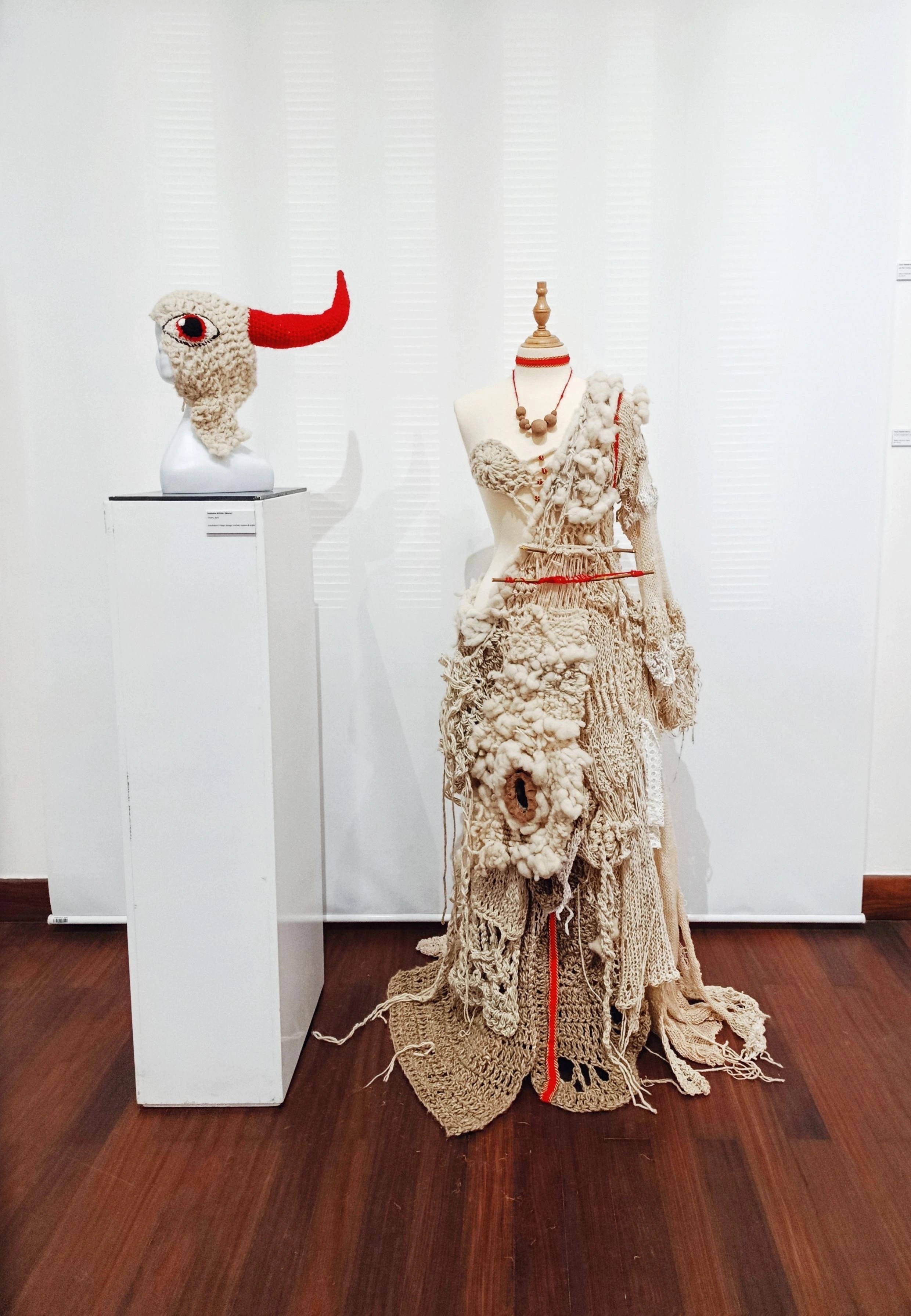
Your practice spans crochet, knitting, sewing, photography, and drawing. What does moving between these mediums enable you to express? How do these forms of making interact or speak to each other within your creative process?
Moving between these practices enables me to, as Es Devlin says, “animate the idea”. These different forms of expression touch different parts of my soul, or maybe unconsciousness.
A crochet piece is made of many knots, hundreds, and sometimes thousands of stitches. When I create a mask, for example, the design is not the only way to express myself or ideas; it’s also the number of stitches in the baseline, the tension of the yarn, and the anatomy of the stitches themselves. The design is for me, and you; the other details are a little secret for me, and they often refer to the complexity of our being, the many knots we’re made of, or the many knots we’re dealing with trying to undo.
The same goes for photography; it’s an added layer to the piece, it allows me to express more, to complete the meaning, or sometimes, by taking self-portraits, I also take a moment to pause, step back, behind the camera, and take a look at myself, from a hopefully objective point of view. At that time, when I wear a crochet installation for example, and pose for a self-portrait, I become detached from the person I see when I check the camera, I become a photographer,
Because I lent my body to the idea, and the idea has come alive through me, I am no longer there, but I am also present; it’s weird, jumping between all these mediums helps me navigate the troubles I have with constructing a unified or somewhat stable idea about my identity, and who I am. Thus, as much as I’d like to say I am using multiple mediums to express myself as best as I can, in the very beginning, this multitude came from my need to simply deal with my psych.
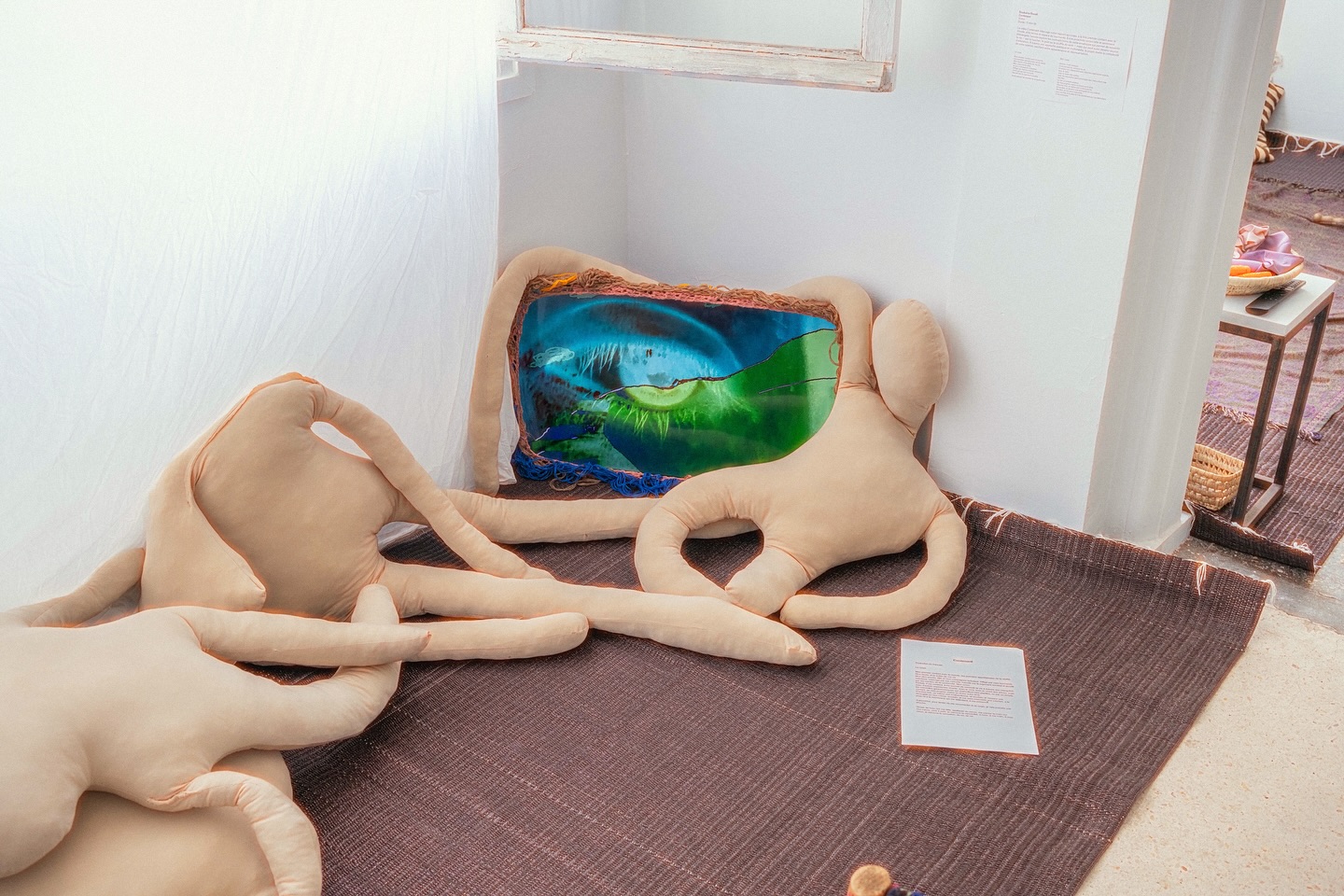
Your work often explores femininity, the body, identity, and mental health. How do you navigate these deeply personal themes when translating them into visual and material expression? In what ways is your work both vulnerable and empowering for you?
I treat these subjects with the utmost respect and solemnity.
When I was 19, I first stumbled upon psychology, and that’s when I found out that I’m actually not possessed by demons like my family said, but simply troubled, or maybe just different. This realisation made me look more into psychoanalysis, literature on existential matters, and the Quran. After a couple of years of self paced studies, I decided that whatever I’m dealing with, should not be treated as tragedy, or drama, or a story I tell anyone I meet, I should treat my symptoms, my troubled relationship with my body, the unfair dogma and interpretation of Islam forced on me, etc., all these subjects should be treated as such: subjects of study, question, reflexion, a study that feels like a ritual with myself that will probably continue until I die.
To give a concrete example, when I worked on the series “Haunted,” because the project came at a time of departure from a certain life I had before, to a new chapter, I was already very emotional, to avoid that this surge of emotions would throw me into an episode or would hinder me from coming up with ideas, I treated the project as a ritual. Haunted symbolised for me a life after being dead for 28 years, and thinking I was alive. An old version of me died when I left home last year, when I emancipated, but I never got to grieve appropriately.
So, I started preparing for my own funeral. I dug my grave, and every day for two weeks, I would sit at it, read or listen to the Quran, pray for myself, and cry. I did that, visited the grave installation multiple times, before even deciding the direction of the photographs. I was very stern at the site, respectful, and there was an almost religious air to this. Which ate me up. The whole experience was so intense, and on the last day of the shoot, I cried until I fell asleep.
After completing “Haunted,” I had no energy to start another project, but I felt like I did the meaning behind it justice. I gave myself a way to grieve, to say goodbye to that old, dead self, and to welcome this new chapter. Because these subjects are literally from my flesh and blood, very personal, I try to tread carefully by dealing with them as subjects that can be studied through artistic expression, and subjects that are not related only to me, but, in a way, if I go through all this pain, and make something that resonates, that has meaning, maybe, it could help someone else who’s going through the same thing.
You describe your practice as a process of exploration rather than arriving at definitive answers. When beginning a new piece, what usually starts the journey? Is it an emotion, a memory, a visual idea, or a question? And how do you sense when a work has reached its conclusion?
What usually starts a piece is a question, often about an angle I have trouble writing about. Coming back to haunted, for example, I could not write in my diaries about the experience of this symbolic death, and even if I wrote about it, I don’t think I’d be able to observe it or study it as deeply as I could by working on the grave, the textile piece and the photographs.
I sense that a work has reached its conclusion when I finish sequencing, for example, and I don’t feel the need to add anything, or retake any photographs, and also when I feel within myself that I’m ready to move to the next question, subject, or project.
Amazigh and Moroccan craft traditions play a big role in your aesthetic language. Could you speak about your connection to this heritage and how ancestral memory informs your choices of color, texture, symbolism, or materials?
My connection to this heritage comes from the women in my family. I feel that holding on to crafts and my Amazigh ancestry is very helpful in maintaining that sensibility about my femininity and a certain stability to my identity, by grounding it in a strong liaison with the land and nature, something that is very important and spiritual in Amazigh culture.
In my grandma’s house, nothing was left to waste; everything was used, recycled, and even fabric scraps were repurposed as rugs. This resulted in households full of vibrant colour combinations, different textures coming together ( plastic from flour bags and woollen threads) .
Your work carries a strong sense of resistance, especially against conservative expectations surrounding womanhood and identity. In what ways do you view your artistic practice as an act of rebellion or reclamation? How do you navigate the balance between honoring tradition and asserting your own agency?
My practice is an act of rebellion, because it was the only act besides thought that I could do in the seclusion and privacy of my room, that my family’s dogma and restraints couldn’t reach. Through crochet pieces, portraits, and film, I could create a world of freedom, unrestricted imagination, and a sense of being. This means that despite having a strong sense of belonging to my ancestry and a strong relationship with my heritage, as well as respect, I still try to keep a safe distance from all this to allow me to also be critical, innovative or more realistic.
Finally, are there any upcoming projects or directions you are currently excited to pursue?
I recently took on making mixed media photo zines as a new medium. I am still exploring the intersections of this medium with my current practices and its possibilities. Still, I would love to delve more into telling my story and others’ through flipbooks.
Check out her works on Instagram.
 Mediterranean Commune*