
Melis Erdem is an Artist and Cultural Curator based in London, UK, originally from Türkiye. She is the founder of Mother Tongue, a cultural platform dedicated to exploring heritage, memory, and belonging through objects and stories. With roots in Mersin and a creative life shaped between İstanbul and London, Melis carries a deeply personal and nuanced understanding of identity, displacement, and home.
In this interview, Melis talked about the personal journey that inspired her to found Mother Tongue, how objects carry the emotional weight of home, her early influences from family and museum work, and the importance of reclaiming narratives about Türkiye.
We’d love to know more about who you are, not just professionally, but personally. Where are you originally from, where are you currently based, and is there something about you that might surprise people or reveal a side of you we don’t often see?
I was born in the South Coast of Türkiye (Mersin) and raised in İstanbul. I moved to the UK when I was 16. And although I am now based in London, in truth, I’ve been in between East and West ever since.
People are often surprised when I tell them I’m a gamer! I love games and their power to engage you in a story; it truly is like nothing else. I dare anyone to play the first 20 minutes of The Last of Us and not weep! Plus, a good game gives you the same escape as if you were dancing like nobody is watching; it transports both your mind and your body elsewhere – it’s the opposite of that vegetable feeling.
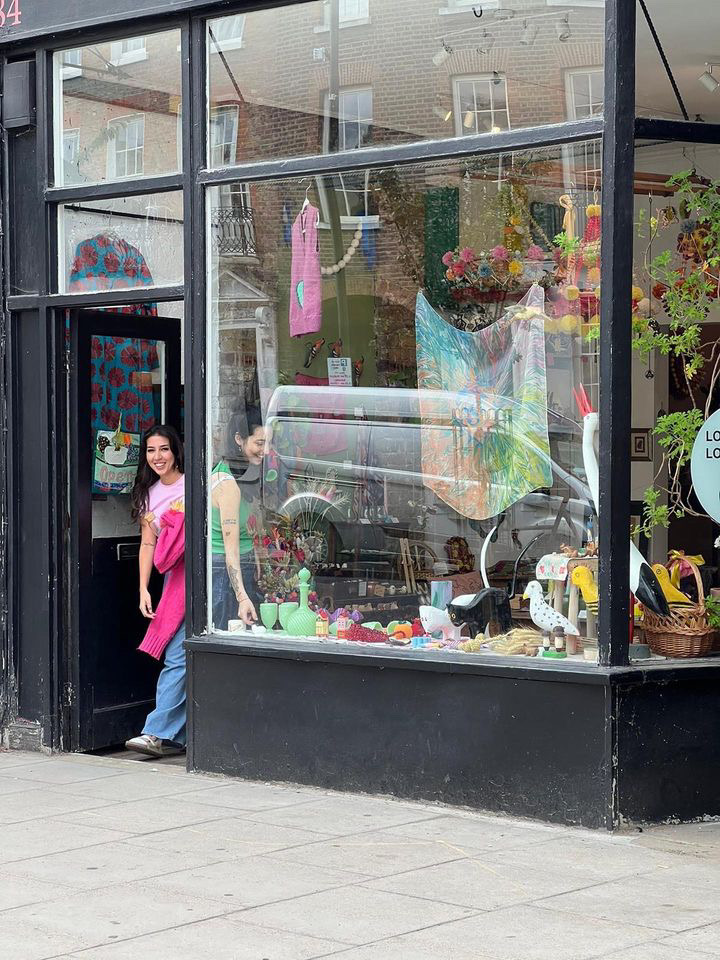
What inspired you to start this journey? Was there a particular moment, conversation, or realization that set things in motion?
What set things in motion for me was moving away from home. I had to live away for some time to truly confront how my home is perceived from the outside. The global narrative that was prevalent back home felt like the foundation of Western cultures: the notion of the East (namely Türkiye) as a place of unrest and its people as uncivilised — a so-called “Third World” country with good beaches — while the quality of everything, both life and people alike, was believed to be found in the West. I could have — like many of my people do — consumed and regurgitated this without surprising anyone, but I saw an entirely different truth. So I decided to fight this perception in the only way I know how.
Mother Tongue is an amalgamation of everything I naturally do – of course, with the added discipline. I always tell people about how, as a kid, I used to dream of curating my collection of objects in my future, adult home. When I left my last job in 2020, having been subjected to many different versions of this perception about Türkiye, I had the urge to start hacking away at the stone until it formed into something. I was shocked at how much I already knew about this business I hadn’t even built yet. So much of it was already in my head, brewing underground with every interaction. People talk about creative projects like they “birthed” something; in that sense, mine was more like throwing up.
We’re curious to hear about early influences, whether a specific artifact, a childhood memory, or a moment that made you pause and look at everyday objects differently.
My earliest influence was probably my great uncle Erdal, who was an avid collector (though perhaps he didn’t call himself that) and a part of our nuclear family. When I looked at his collection -largely of natural origin- they told me about his adventures. Made up of giant iridescent shells he found deep diving into the sea, to hats worn by the most adventurous of cowboys, or so I imagined… When Erdal moved in with us, suddenly I was under the same roof with these things I had only seen in films and taken for granted. It was then that I started thinking about their life story, both pre- and post- my great uncle.
This way of thinking was cemented in my head when I started working at the Natural History Museum almost a decade ago. Using the objects in their collections to engage the public about the natural world, I learnt which questions to ask to find clues on any given object, human-made or otherwise. There, I gained the skill to truly see objects. From that poin,t there was no going back, as I felt like I had just levelled up!
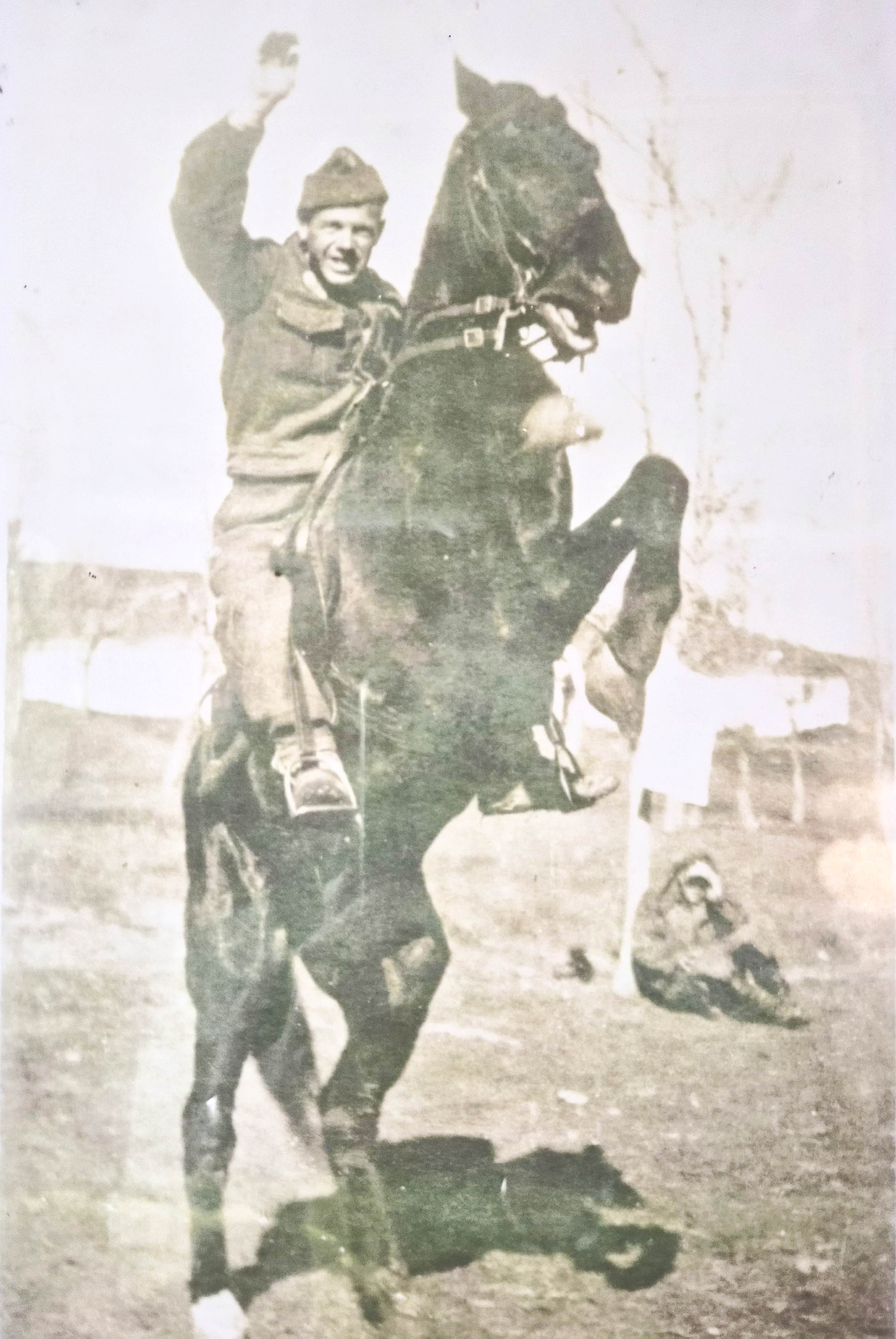
What does the idea of “home” mean to you within the context of this project? Is it tied to a place, a language, a feeling, or something else entirely?
More than anything, home is a feeling. It is possible for it to be a place, like a building with a ceiling, or a language, like your mother tongue, but these alone are not enough to make you feel at home. Home is your personal culture; personal as in unique -rather than concerned with individualism- and built up on connection. Surprisingly, it is also something you can carry with you, but you won’t be doing the heavy lifting.
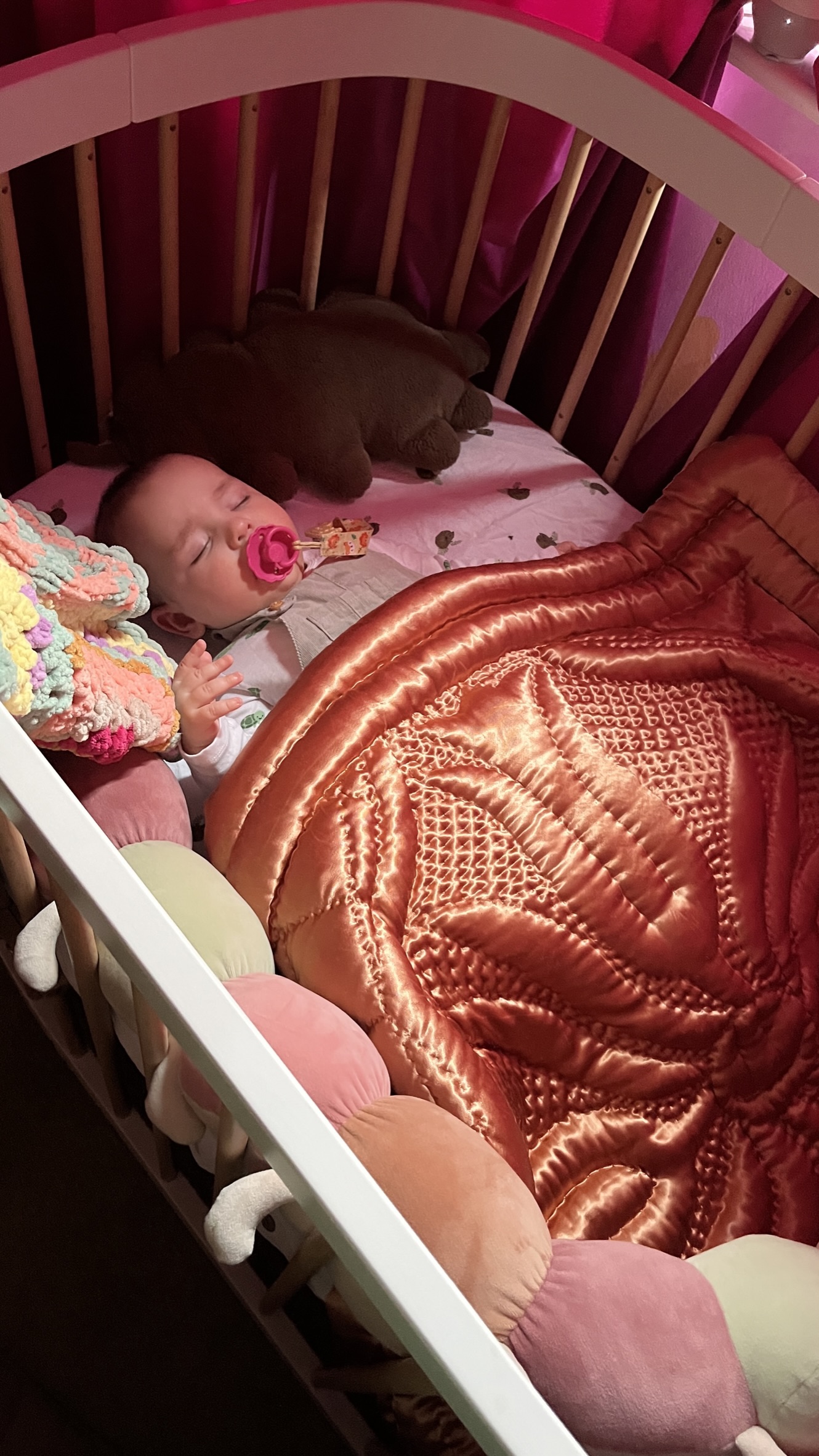
The objects which accompany you throughout your life, symbols of the connections you made and things you’ve felt; a simple pebble from that peaceful day at the beach, a cowboy hat passed down from your adventurous great uncle, or an embroidered textile piece you bought on your first solo holiday since having a baby… These objects do the heavy lifting of carrying your culture, heritage and home around with you. They are powerful, for which they can symbolise what you choose to keep, what you choose to call home.
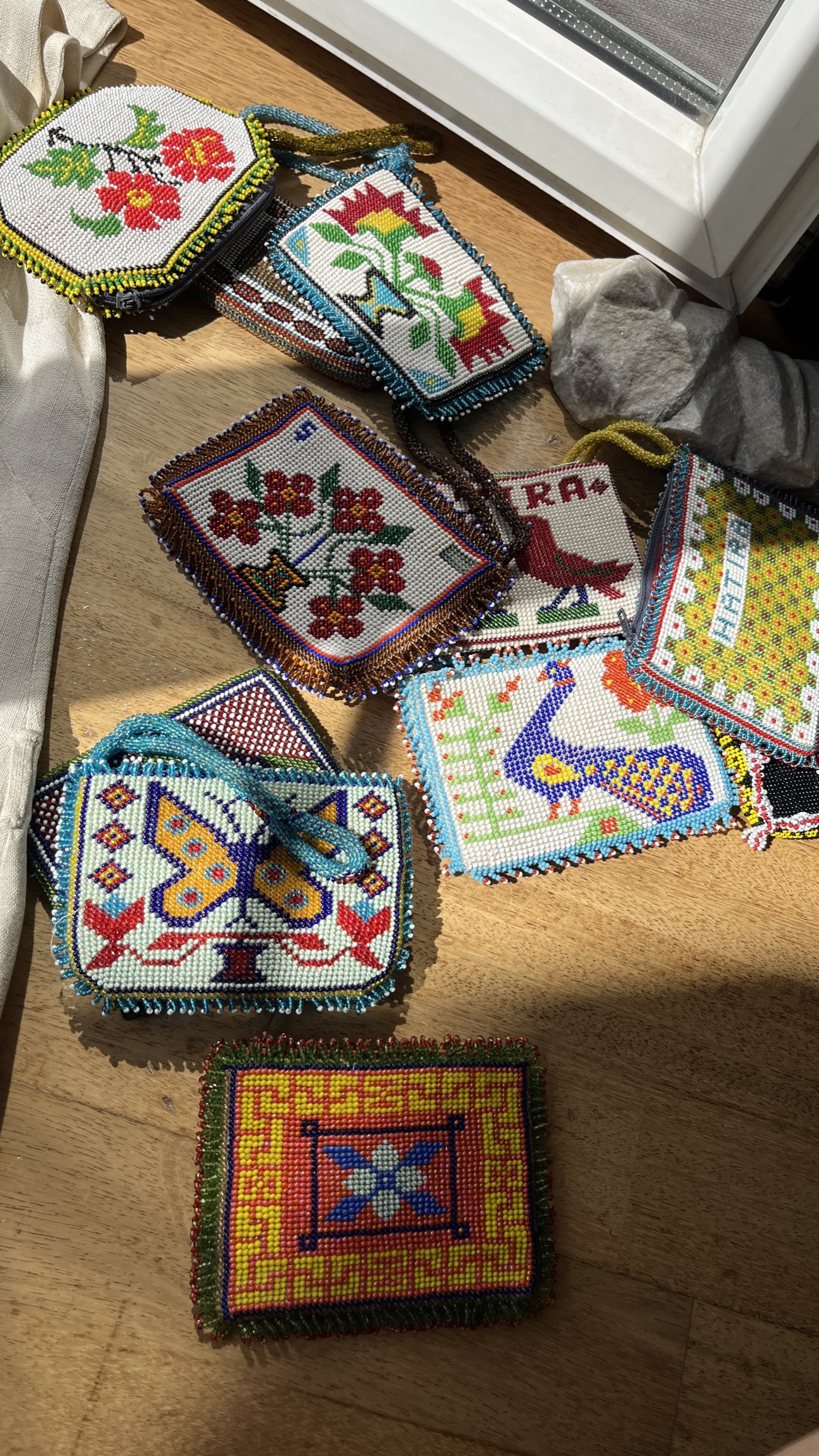
Can you share a specific piece from your collection whose story stayed with you, perhaps something that moved you deeply or challenged how you see the world?
There are some really touching beaded purses made by men in prisons of Türkiye that have forever altered the way I think about prisoners and of men. Tiny glass beads are arranged to create beautiful, feminine designs, but there is more to them than that. Dating back a century ago to Türkiye’s War of Independence and originally made by Prisoners of War, they have been taught from master to apprentice since. These one-off pieces I call Prison Beadworks often depict symbols of freedom in the shape of a butterfly, for instance, or the name of someone dear to the maker, or if you’re really lucky, even a message from the maker. Rarely do you get a personal glimpse into the heart of a prisoner, or into the heart of men, for that matter.
The piece in Mother Tongue’s Collection that gives me goosebumps every time is one of these purses, made in prison by a male prisoner 30-40 years ago – a very simple design by comparison, about 6×5 cm big, white beads on the background with contrasting black text on one side reading “Canım Kızım” and the other reading “Neden Kızım”. When translated, that reads “My Darling Daughter | Why My Daughter”. No other words are needed.
Are there upcoming collaborations, pieces, or themes that you’re particularly looking forward to exploring or sharing with your audience?
Yes to all of the above! We have a new collection around the corner, an upcoming collaboration, a little rebrand and a brand new arm of Mother Tongue to launch by the new year. This new arm will not be focused directly on objects, but on film! Sitting at the edge of my seat for this one, but no more spoilers for now. The collaboration will explore the churches mentioned in the Bible – all seven of which are located in modern day Türkiye. But by far the most exciting of all is that we’re looking for our new brick and mortar space in 2026 to launch Mother Tongue 2.0; a brand new place with an even more comprehensive dive into Türkiye’s rich culture, and a place where we can be a melting pot once again.
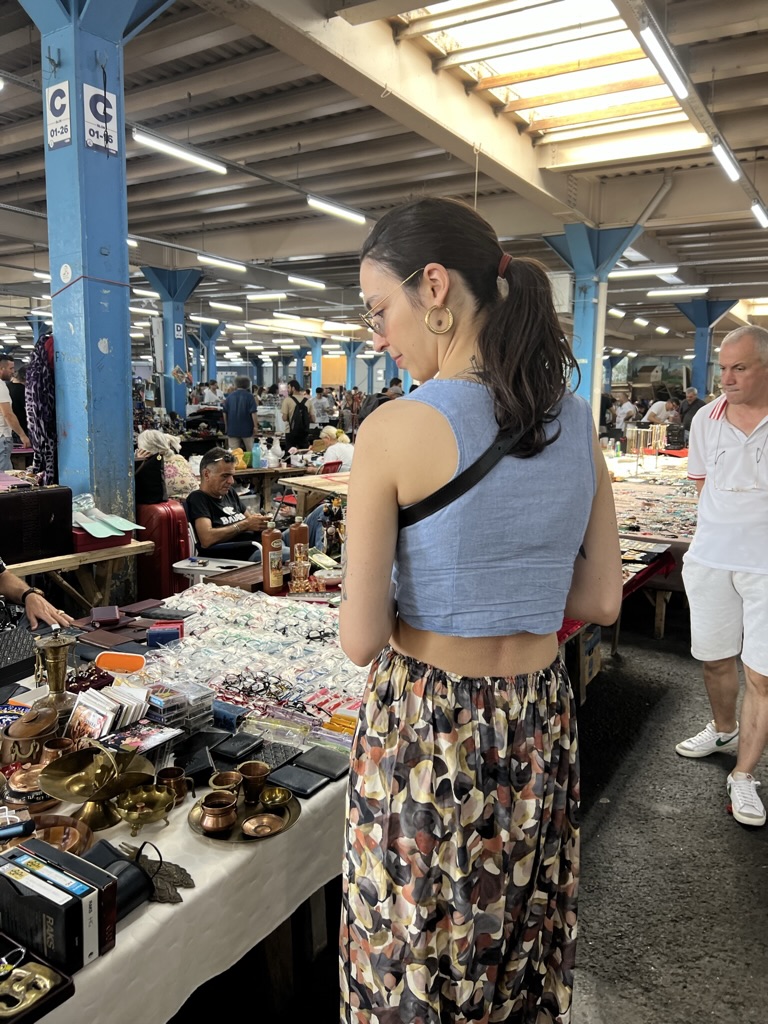
How do you personally approach storytelling in a way that feels slow, intentional, and meaningful?
I only tell stories that I actually care about, and I let it take time. Because time (and space) leads me to meaning. Stories are complex; they change depending on who, when and where you are. The patience to let a story unravel and develop is what takes you to where you didn’t expect to find yourself at the start. The challenge for cultural projects like mine is to not get lost in this depth; to tell the story in a meaningful way while still keeping it digestible for your audience.
Of course, in a business, there are times you need things quickly to progress, but if you are in the business of storytelling like me, it’s crucial to structure your time so that you mix storytelling with things that are less deep or more straightforward, for example, planning or cataloguing. That way, you can let the story mull over in the background (your subconscious) while you work on some of the core aspects that keep your business running.
What’s something you’ve learned along the way that you wish you’d known at the start or a piece of wisdom that’s stuck with you?
The widely accepted narratives of the world are there to uphold ideals to someone’s benefit, not to tell the truth. So rewrite the story and have confidence in your own truth.
Also, for more check out Mother Tongue’s website.
 Mediterranean Commune*