
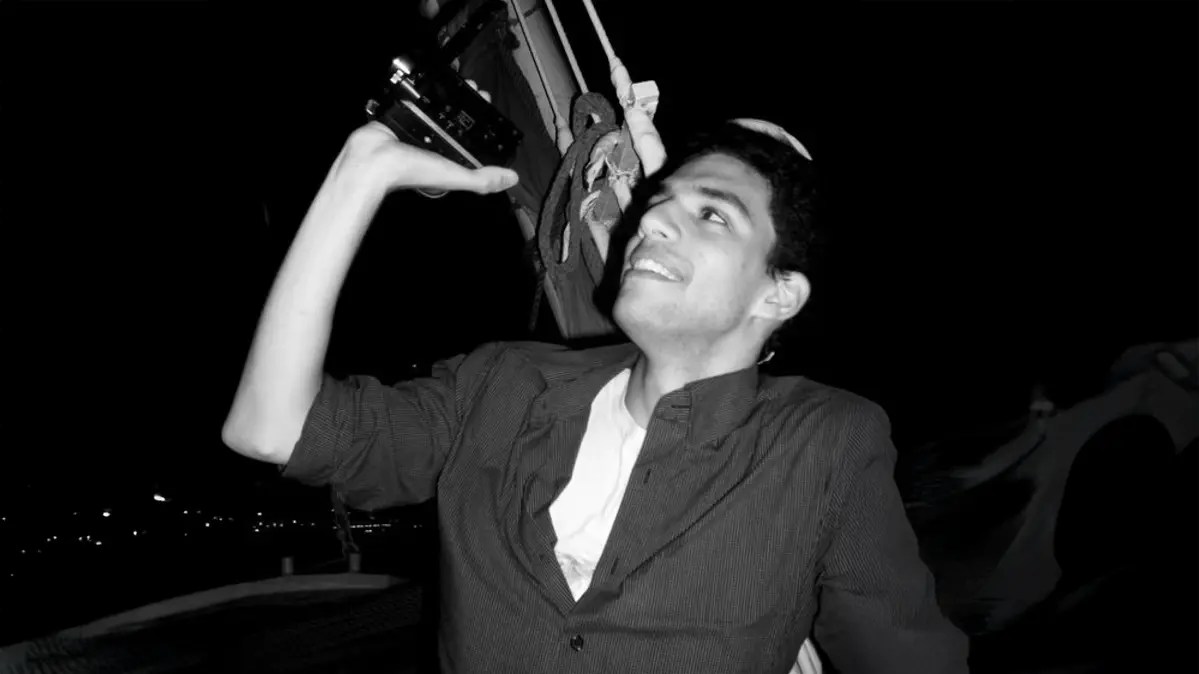
Taher Abdel-Ghani is a Cairo-based architect, urban researcher, assistant lecturer at New Giza University, and award-winning independent filmmaker. With a multidisciplinary approach that blends architecture, urbanism, and visual storytelling, Taher’s work delves into cinematic urbanism, architectural pedagogy, and spatial and visual culture.
Having lived in four countries—Saudi Arabia, Egypt, Germany, and China—his experiences have shaped a global perspective on urban environments and cultural narratives. Taher’s experimental documentary films explore the dynamic relationship between people and urban spaces, with a strong focus on Cairo’s ever-evolving urban landscape.
During the interview, Taher discussed Cairo’s chaotic yet harmonious character, referring to it as a city that “just happens.” Inspired by theories like Nikos Salingaros’ “P2P Urbanism,” he sees the city as a living organism constantly in flux. His ongoing PhD project aims to archive cinematic scenes of Cairo from the 1950s to the 1990s, documenting its spatial transformations and socio-economic shifts.
Can you introduce yourself? Where are you from, what do you do, and is there anything about your journey or background you’d like to share with us?
I’m Taher Abdel-Ghani from Cairo, an architect, an urban researcher, an assistant lecturer at New Giza University, and an award-winning independent filmmaker. My research focus ranges across several disciplines, from cinematic urbanism, and architectural pedagogy, to spatial and visual culture. I consider myself lucky to have lived in four different countries, Saudi Arabia, where I was born, Egypt where I currently live, Germany, and China, both of which I studied my master’s degree in Advanced Urbanism.
Your work focuses on analysing urban environments through cinematic images. How did you first develop an interest in this intersection of urbanism and film, and what has been your approach to cinematic urbanism?
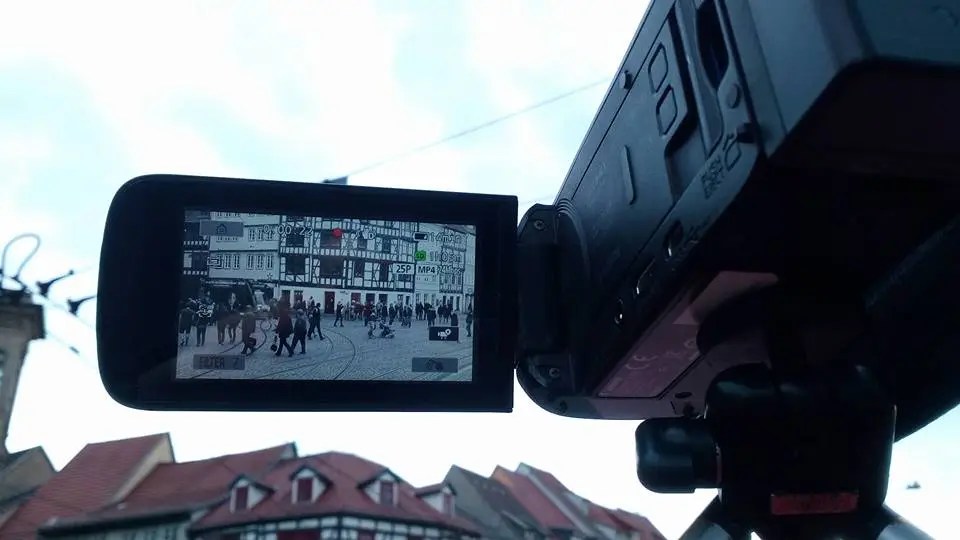
I first developed this interest during my 4th undergraduate year in Architecture in 2011, right after the January 25th revolution. It was a design studio course where we were required to develop in-between spaces in Downtown Cairo, the area that was central to the protests. The course instructor asked me and a friend of mine to document the process and make a series of short film about it which we eventually did and gained the admiration of everyone. At the time, I was very interested in documenting people and spaces around us, but never fully grasped the idea of cinematic urbanism till I started my second year in my masters studies. This is when I, along with the help of my supervisors, developed a framework that would be applicable to the imagery analysis of cities, i.e. looking at cities as a series of cinematic images that include a triad of space, image, and narrative.
I realized that Cinema cannot be reduced to just films, just like Architecture cannot be reduced to just physical buildings, but a way of thinking, a culture, a way to find unanswered questions. Factoring in my passion for film since I was six, I started to discover how cinematic documentation of the city can shape my perception of it through looking at the smallest details, which later on I learnt it to be called Everyday Urbanism.
How has Egyptian culture and its unique urban landscapes influenced your work? Are there particular aspects of Cairo’s environment that inspire your projects?
I once came up with this quote, “Cairo is a city that just happens”. I see Cairo as an accumulation of informal practices that shape the everyday culture. It is chaotic, but harmonious at the same time. Here, I want to refer to the book P2P Urbanism by Greek Mathematician Nikos Salingaros applying theories of complexity and networks on architectural and urban design, where he refers to Cairo as an example of how cities can be viewed as living organisms instead of static spaces that are subject to governmental control. This approach inspired me to look at urban spaces as a series of daily transformations, just like the frames of a film, in a constant flux. My master thesis, and currently my research work, explores this dynamic nature of Cairene spaces in Egyptian cinema. Alongside the research work, my short films documents people’s intricate relationships they have with urban spaces in a more an experimental-documentary format.
As an urban researcher myself, I’m always excited to see other urbanists exploring intersections with different fields and using diverse tools. How do you view the role of our educational background in shaping these interdisciplinary interests? And as a lecturer, do you believe the specific field we come from plays a significant role in how we approach these intersections?
If I would refer to my educational background, I would point out the course that I mentioned earlier that encouraged me to merge cinema and architecture into my design studio project. Education’s role is to foster inter-disciplinary studies to equip students with specialized knowledge and critical thinking skills. Yet, there is a major setback in enhancing such skills in the design studio, as now Education has become a major subject of consumerism at the expense of core knowledge. Hence, pedagogical models, at least in my home country, have become commodified by the rules and regulations of the market, leaving little space for criticism and innovation.
I keep saying that in order to tackle this issue, education should lead the market, not the other way around. Architecture students should be given the space to experiment and come up with innovative and feasible approaches that can address the current environment’s issues, e.g. climate change, poverty, migrant crisis, war, etc.
I think today we should look more into the trans-disciplinary approach, which transcends the boundaries between the different fields. The design studio has the potential of being a hub of disciplines working together fruitfully and productively. As a lecturer who has been in the field for 5 years, which is considered a newcomer actually, I tend to introduce new fields of research in the students’ works. Today, it is very different than the time when I first went to college in 2007. Knowledge is developing at great speed and so are the tools at even greater speed. Being overwhelmed with so much resources, it requires that a team of diverse academic backgrounds come and work collectively. I don’t see a bright future for individualism, i.e. what is referred to as ‘Starchitects’.
Can you recommend three films that have had a significant impact on your work?
2001: A Space Odyssey (1968) by Stanley Kubrick, The Great Beauty (2013) by Paolo Sorrentino and Alphaville (1965) by Jean-Luc Godard.
I would like also to recommend an Egyptian film, An Egyptian Story (1982) by Youssef Chahine.
What upcoming projects are you currently working on, and is there anything you’re particularly excited about?
Currently, I’m working on my PhD thesis, which is planned to be a future book project. To give you a brief about it, it will be a compiled archive of cinematic scenes shot in different parts of Cairo spanning from the 1950s till the 1990s. It documents not only the spatial transformations of the area but also the socio-economic changing patterns in these areas and how societal behavior within these spaces changed over time.
My biggest aim though, at least for the near future, is to establish a research platform on cinematic urbanism, inviting scholars and filmmakers to engage in discussions, workshops, seminars, and also filmmaking.
What advice would you give to young creatives who are interested in combining urban research, architecture, and film in their work?
Read, read, and read. The most important advice is reading and inducing your brain with up-to-date knowledge. Watch movies with a different eye. They need to deepen their insights into each of these fields and try to find the sweet spot that suits their creative minds. They can take the camera and start wandering in the streets aimlessly just to discover their unique visual perspectives.
Reaching this level requires them to engage with different backgrounds and to socialize and network with people who share the same passion. Attend film festivals, conferences, public lectures, and meet people there. Also, and this is very important, is to show their work to a public audience, whether it’s a movie or a research paper or a lecture. Accept criticism, be resilient, and work on another project and show it to the audience.
 Mediterranean Commune*