
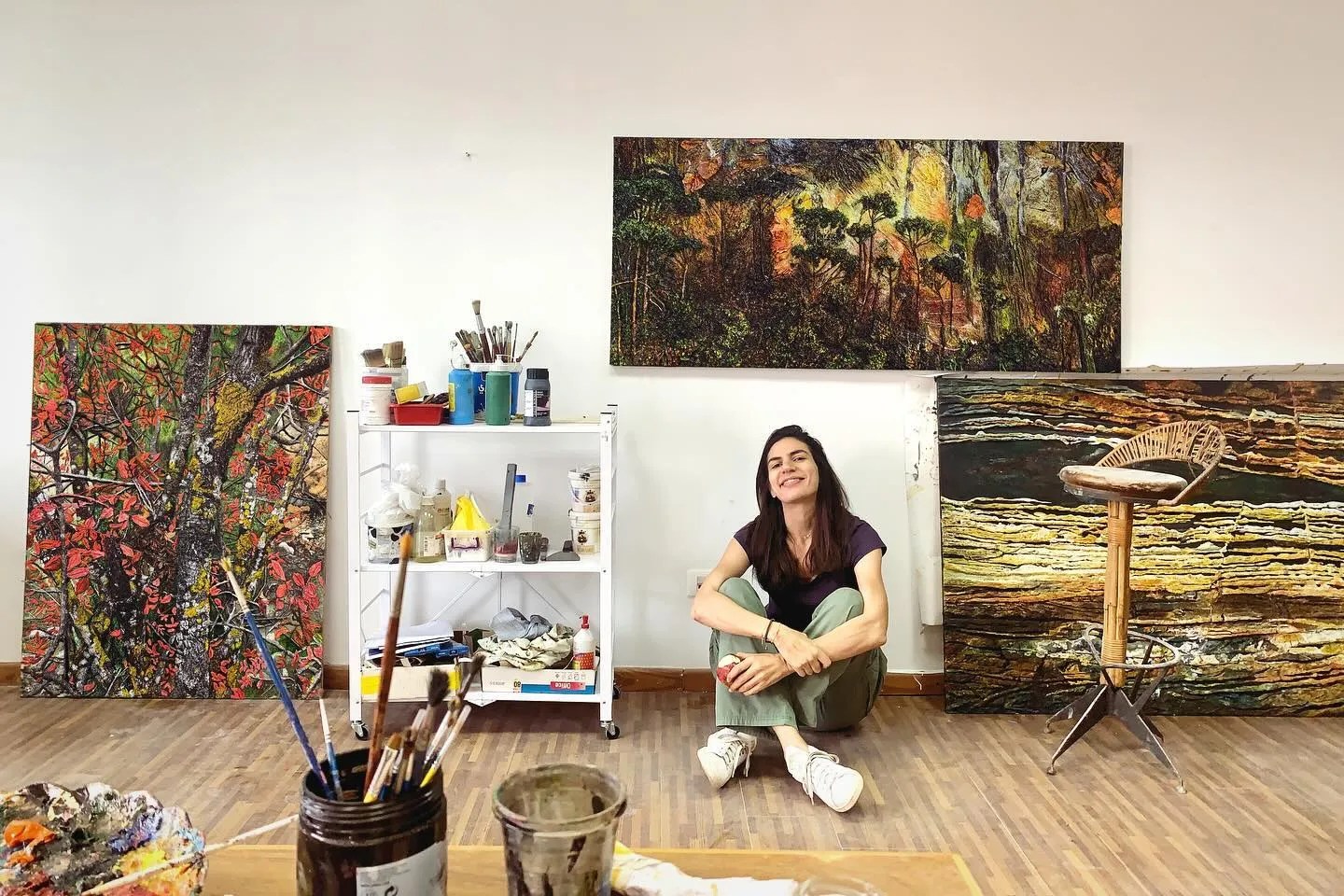
Tamara Haddad is the first guest of Mediterranean Commune’s interview series, where we explore creativity, Mediterranean identity, culture, and personal journeys.
Tamara, a Lebanese artist based in Beirut, combines her passion for nature, photography, and environmental advocacy in her works. With a background in advertising and a master’s degree from ALBA, she transitioned to painting full-time in 2011, driven by her deep concern for the earth’s landscapes. Inspired by her architectural heritage and global travels, Tamara integrates natural materials like sand, bark, and pebbles into her paintings, highlighting the beauty and fragility of the environment.
To learn more about Tamara’s works, please check her portfolio.
In this interview, she reflects on her creative journey, Mediterranean identity, and commitment to sustainability.

Can you share few information about yourself, where are you originally, current location, your art style and few personal details you would like to share.
I was in Beirut in 1982, I graduated from Académie Libanaise des Beaux-Arts (ALBA) in 2005 with a master’s degree in Advertising. I started painting in 2004 as a self-taught painter while working in advertising. In 2011 I quit an advertising agency to devote myself to painting. I live and work in Beirut. My art is mainly focused on environmental issues that affect our landscapes, using natural materials along with painting and photography.
How would you describe your creative process, and what recurring themes or ideas do you explore in your work?
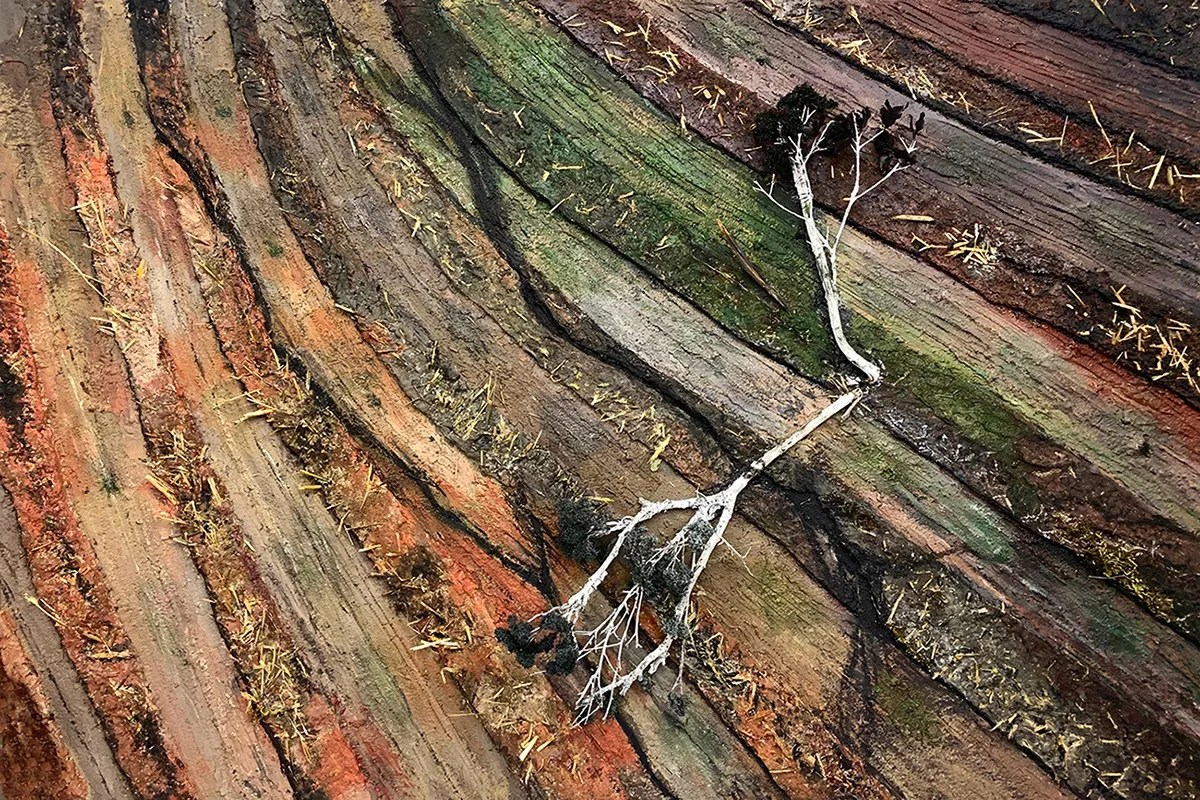
Deeply influenced by architecture and photography, being the daughter of Georges Haddad, a pioneer of modern architecture in Lebanon, I take inspiration from my photos either taken during trips around the world or during hikes in Lebanese mountains and abroad. Today my work is focused on physical transformations that the earth is enduring nowadays mainly caused by mankind’s actions. I insist on the changes that affect the earth’s landscapes and its geology, showing scars, but at the same time, revealing the beauty and the variety of colors and textures that Earth owns. Having a deep concern about the environment, using natural materials such as sand, bark, straw, pebble and branches along with oil painting, is part of my process.
Your work often incorporates natural materials like sand, bark, and pebbles. What draws you to these materials, and how do they enhance the themes you explore?
Using natural materials is part of my process to deal with Earth landscapes, I want people to feel earth and nature, to get close to it. The texture is very important in my art, it is the earth’s language.
What does the concept of “being Mediterranean” mean to you, and how does it influence your work?
Being Mediterranean defines a lot of our behavior, we, in Mediterranean people. We are warm people, we are very expressive and creative, we are open to the world because of the sea, we move a lot, we are curious to see what is behind the sea, migrating has always been a part of our lives, especially in Lebanon. Besides, the Mediterranean means also a polluted sea. It is the most polluted sea in the world. Because of Mediterranean countries. This couldn’t but affect my work, as I shed light on environmental issues.
As an artist rooted in Lebanon, how do you see your work contributing to the broader dialogue around art, nature, and sustainability in the region?
As an artist in Lebanon, I have a lot to say about the environment in general, and more specifically in Lebanon, as this country has a big issue with environment. Unfortunately, there is a lot to be done, starting with educating kids on environmental behaviors. No need to say that natural landscapes in Lebanon are being constantly destroyed and affected by people and governments who allow massive destruction of trees, mountains, and sea, to build horrors. Being very sensitive to this subject, I try to express it in my art, willing to share my worries with other countries. But at the same time, I always say and show that Nature will prevail over our actions.

Can you share a specific memory from your time growing up by the Mediterranean that has shaped your perspective?
As I grew up in Beirut and went to the beach since I was little, I am shocked by the level of pollution that increased a lot. A few years ago the beach in Jiyyeh was almost clean. Today I can’t swim there anymore. Same for Jbeil and Chekka. This is one of the environmental issues I work on through my paintings.
What advice would you give to aspiring artists?
Always work on things that really matter to you, things that affect your life and your vision. It can be negative things as well as happy matters. Be honest and genuine in your art. This is the only thing that appear.
🌱 Follow Tamara Haddad’s creative journey on Instagram, Website, and Galerie Tanit.
 Mediterranean Commune*